
Suppress that Appetite
It appears that when you take a powerful and effective appetite suppressant (GLP-1s etc.), you can starve yourself of calories and nutrients because your body’s signal that you need to eat is turned off or at least turned down. That starvation can create a cycle where you not only reduce your bodyfat but your muscles also atrophy, (waste away). Then you might go off your appetite suppressants and become hungry again. When you return to eating normally for you, returning to your previous behavior/old habits, you might replenish your bodyfat (and then some). However without a concerted effort to rebuild your muscles (create muscle hypertrophy) you will be fatter but with less muscle mass than before. That sounds fantastic! A medically supported way to become “skinny fat”.
Semaglutides, GLP, GIP, glucagon and their various combinations (GLPs) are thought to primarily suppress appetite potentially along 4 different dimensions. It is also suspected that they might create some increased fat burning (fat mobilization and fat oxidation). To this point in time, it is unclear if any increased fat mobilization or oxidation is happening at all or if it is attributable to the GLPs . In any case, that potential fat mobilization and oxidation is so minimal it can be disregarded.
- In a nutshell, the GLPs appear to be effective at helping to maintain the behavioral modifications required to maintain a caloric deficit. That is, your appetite is suppressed so you are not as motivated to eat as you normally would be.
- Any additional benefits from GLP use look most likely to be knock-on effects from reduced body weight that can happen through various other means with or without the GLP.
The reported side effects might include nausea, vomiting, constipation and diarrhea. The outlier side effects are severe and include blindness, gastroparesis (food stops moving through the gut) and suicidal ideation. Those severe outliers are barely statistically relevant and it is difficult to say what is truly going on there and how attributable it is to the GLP use. Maybe that is a risk some people are willing to take.
It is critical to know that even with or especially with a GLP program, you still need sufficient calories and nutrients to avoid muscle atrophy (muscle loss) and healthy body functions. Depending upon the diet you are on as a result of your appetite suppression, you may be starving yourself of the vital nutrients to be healthy. If you go down the GLP path, combine it with a diet and supplement program to feed the body correctly to maintain good health.
Maintain that Muscle Mass
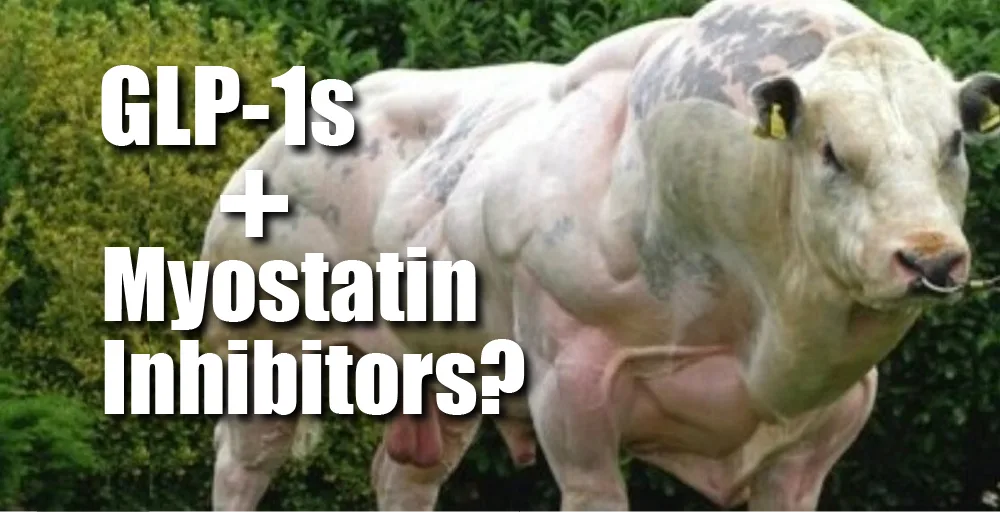
Never fear skinny fat people because there is more “science” to the rescue. What you might not know is that your skeletal muscles want to grow far beyond, bigger and stronger, than what they are at your normal (musculature homeostasis). Your magnificent machine knows that out-of-control muscle hypertrophy is not such a great thing so it uses myostatin which is intended to keep your skeletal muscle growth in check. The purpose of this is to maintain a good balance for what your body is being asked to do on a near-term basis and having out-of-control muscle hypertrophy. Without the myostatin, you might start looking like a Belgian Blue Bull in the above image. This breed of cattle is known for a genetic mutation in its myostatin which leads to 20% more muscle and lean meat than other cattle breeds. Topical for our discussion here is that myostatin inhibitors are currently being developed and have recently advanced through FDA approval for some human use.
Best of Both Worlds? You Still Need the Nutrients
So what if we were to give an appetite suppressant and a myostatin inhibitor to our skinny fat person at the same time? Whatever could go wrong? In any case, that is what is in the works. It is important to note that even with the myostatin inhibitors, you still need sufficient calories and nutrients to enable significant muscular hypertrophy (muscle growth) or to avoid muscle atrophy (muscle loss). Those world-class 320lb bodybuilders have to force themselves to eat almost constantly to achieve that mass. Also when we consider overall health, ponder this,… that 320lb ripped bodybuilder isn’t much healthier than that 320lb tub-of-lard coach potato. Their hearts and the rest of their organs still have to service all of that additional tissue/mass. They still have to carry that weight around everywhere they go. Additionally, in terms of radical muscle hypertrophy occurring over a short period of time, there is also the aspect of the complex systems working together in harmony. For example, when you load up on PEDs which increase muscle mass, the PEDs don’t necessarily increase the flexibility and strength of the surrounding tendons, ligament, and connective tissues to the requisite levels to support this new strength and the forces they can generate. Those types of imbalances can lead to blown knees, shoulders, and other failures.
What is the Point?
I watched one of our PhD Influences talk about this myostatin inhibitor development with a gleam in his eye. In 3-5 years, if some variant of these myostatin inhibitors hit the black or gray market, I too will be interested to see what type of Frankenstein Monsters show up in the gyms and on the sports fields. So, what’s next in this progression? For the body builder, its probably just more extreme bulk and cut cycles. For the skinny fat person, is it GLP1s (appetite suppressant) plus myostatin inhibitors (to preserve and/or build new muscle) plus appetite stimulants (so you want to feed the machine) all at the same time? Probably not. Maybe the skinny fat people will just need the myostatin inhibitors and they can happily live on Doritos, beer, and unlimited consumption. However, there are already plenty of people on gear, who eat poorly, are unhealthy, don’t train well, and look like crap. With all of that said, it seems to me that this entire thing sort of misses the mark. So maybe it’s just more of the same.
Gen-X Elite | 1-on-1 Coaching | Executive Performance | Back in the Game | Strength for Life