
Calories
- What is a Calorie – A calorie is a unit of heat or energy that we use to normalize the different types of macronutrients that we consume, that we put into our bodies. In order to exist, our bodies need calories for energy and to build and repair cells.
- Calories In – Calories Out – You fuel and feed your body with calories and your body consumes or stores those calories. For any given period of time, you will either have a calorie surplus or a calorie deficit. Let’s use a 24-hour day as our period of time. If you take in more calories than you use in a given day, then you have a calorie surplus for that day. If you take in fewer calories that you use then you have a calorie deficit. That calorie surplus or deficit results in your body storing or burning additional body fat.
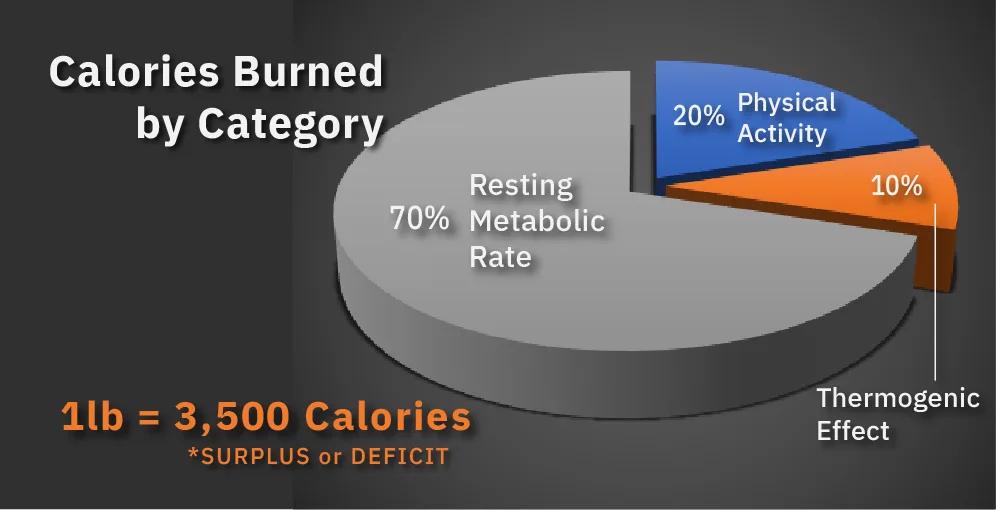
- Calories Burned by Activity – Your body will consume calories in three broad categories:
- 70% Resting Metabolic Rate – Just existing will consume 70% of your daily calories. This includes normal repair and creation of cells, autonomic activities like breathing, your heart beating, repairing and rebuilding tissues, etc.
- 20% Physical Activity – Moving around, doing cardio, lifting weights, and any other physical activity will burn 20% of your daily calories burned. Of course this varies by person and what activities in which they engage.
- 10% Thermogenic Effect – Simply processing, digesting, and absorbing the nutrients that you consume will burn 10% of your daily calories.
Calories to Pounds
The calorie to bodyweight conversion is 3,500 calories = 1lb of bodyweight. So, for every 3,500 calories of surplus or deficit, your body will add or lose 1lb of bodyweight. If you net a 250 calorie deficit a day for 7 days, you will lose ½ a pound of body fat per week. Think of that as a weight loss rate. In this example, a daily 250 calorie deficit equals ½ pound per week.
For frame of reference there are some 250-calories snack examples provided in the adjacent column..
Losing Bodyweight – If you reduce your calories consumed below your baseline maintenance calories for 7-days 250 calories a day (run a 250 calorie deficit) will allow you to lose 1/2lb per week.
Gaining Bodyweight – If you increase your calories consumed above your baseline maintenance calories for 7-days 250 calories a day (run a 250 calorie surplus) will allow you to gain 1/2lb per week.
250-Calorie Snack Examples
- Apple with Peanut Butter: 1 medium apple sliced with 1.5 to 2 tablespoons of natural peanut butter.
- Greek Yogurt and Berries: 1 cup of plain low-fat Greek yogurt topped with 1/2 cup of mixed berries and a small drizzle of honey.
- Cheese and Ham Roll-Up: A whole-wheat tortilla with 1 teaspoon of mustard, 2 thin slices of ham, and 1 tablespoon of shredded cheese, broiled or rolled up.
- Cottage Cheese Bowl: 1/2 cup of cottage cheese topped with a small handful of sliced almonds and cinnamon.
- Air-Popped Popcorn and Nuts: About 3 cups of air-popped popcorn paired with a small 1-ounce handful of mixed nuts or almonds.
- Hard-Boiled Eggs and Fruit: 2 large hard-boiled eggs with a medium orange or a small banana
- McDonald’s Regular Hamburger
Weighing Yourself
You get what you measure, so if you want to change your bodyweight you need to measure it. This means you should consistently weigh yourself. As mentioned earlier, a favorable rate of weight loss could average ½ pound a week. Eight fluid ounces of water weighs about 8.34oz. So if you weighed yourself before and then after drinking a glass of water you could make or break you weight loss target for an entire week. Similarly, you could sway your results if you emptied your bladder or bowels, or if you are more or less dehydrated, before or after you eat.
Like running a science experiment, hold as many variables as constant as you possibly can to get a more accurate measurement. A good strategy is to weigh yourself in the morning shortly after waking, emptying your bladder and bowels, and prior to drinking or eating anything. Keep in mind if you typically have a small dinner at 7pm but the night prior you had a large dinner at 9pm this will also affect your morning weigh-in result.
Since there will be a natural variation in your bodyweight, you should pay more attention to the mean average or the trend of your weigh-in values than the specific daily values. If you weigh yourself just before you go to bed and then at your normal morning time, you might see 3-5 (or more) pounds lost just by sleeping and breathing. There can be many things effecting your morning weigh-in value, so mind the trend and the morning mean.
Gen-X Elite | 1-on-1 Coaching | Executive Performance | Back in the Game | Strength for Life